BJJ for Beginners: How to Survive Your First Month of Training
So you've decided to try Brazilian Jiu-Jitsu. Maybe you watched a UFC event, maybe a friend convinced you, or maybe you just want to get in shape and learn something real. Whatever brought you here, BJJ for beginners is one of the most rewarding journeys you'll ever start — and also one of the most humbling.
Your first month on the mats is going to be a whirlwind. You'll feel confused, sore, excited, frustrated, and then suddenly — something clicks. That moment when a technique actually works against a live partner? There's nothing quite like it. This guide walks you through exactly what to expect during your first month of BJJ, from your very first class to your first sparring session, with practical white belt tips that'll save you time, frustration, and maybe a little dignity.
Whether you're training in Waynesboro, commuting from Charlottesville, or coming over from Fishersville in the Shenandoah Valley, this guide is built for you. Let's get you ready for the mats.
Week 1: Surviving the First Class
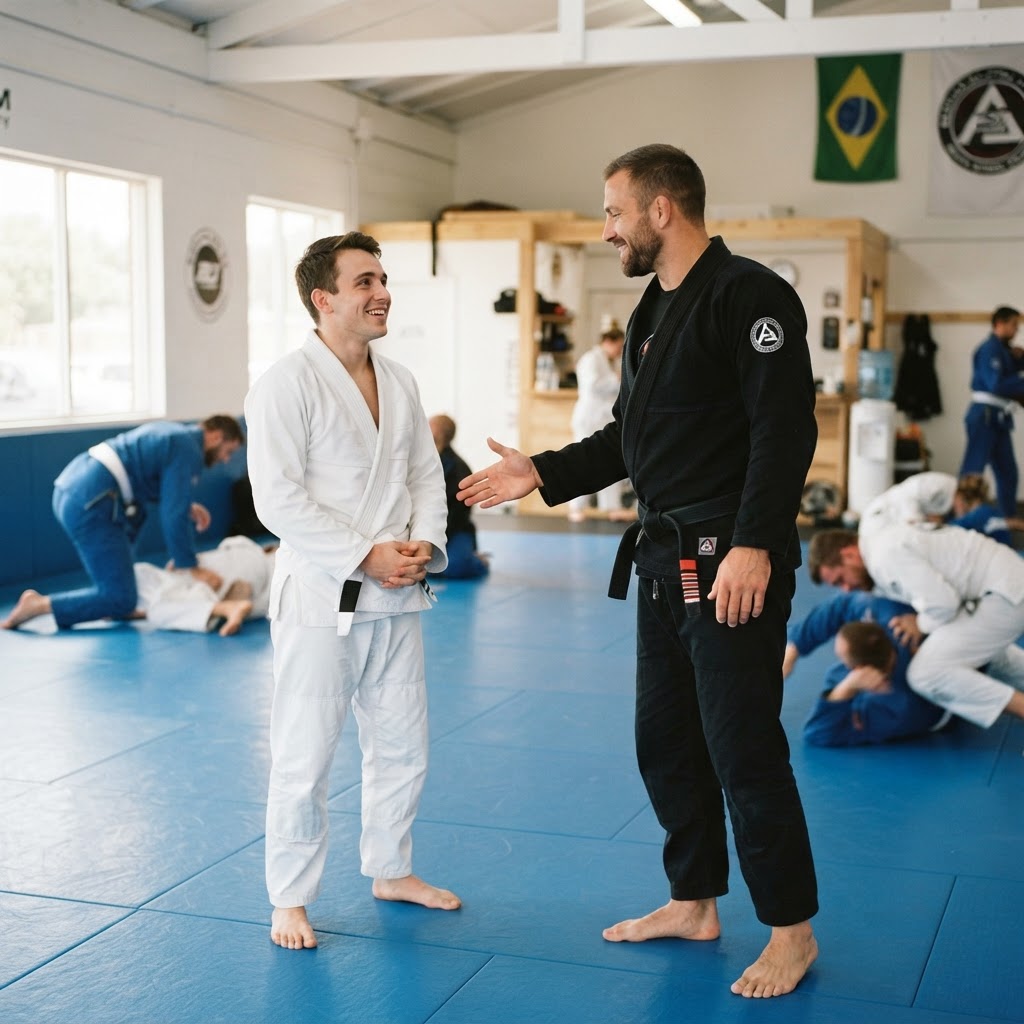
Your first BJJ class is always the hardest — not because of the physical demands, but because of the mental ones. You're walking into an unfamiliar environment, surrounded by people who all seem to know what they're doing. Take a deep breath. Every single person in that room started exactly where you are.
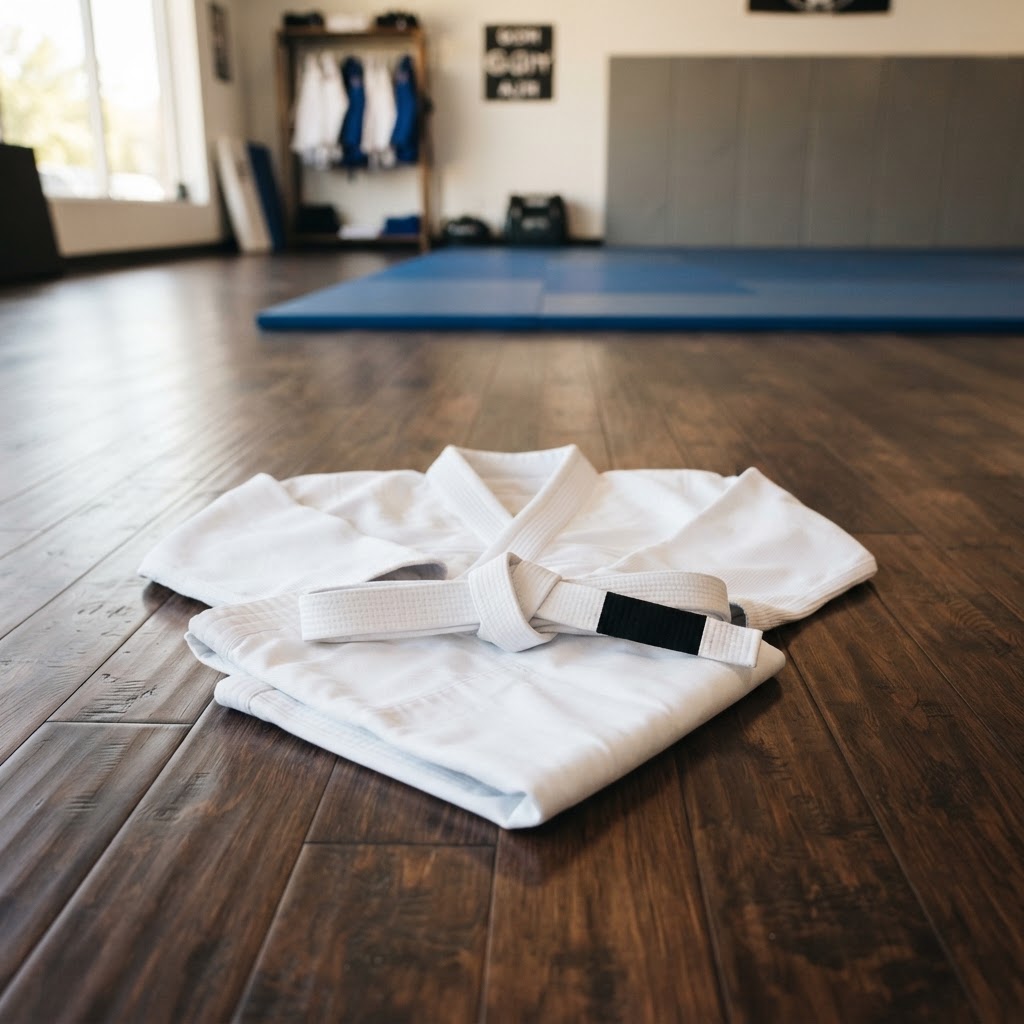
If you haven't already, check out our guide on what to wear to your first BJJ class so you show up prepared. Most academies will lend you a loaner gi for your first few classes, so don't stress about buying one immediately. Just show up in clean clothes, trim your nails, and be ready to learn.
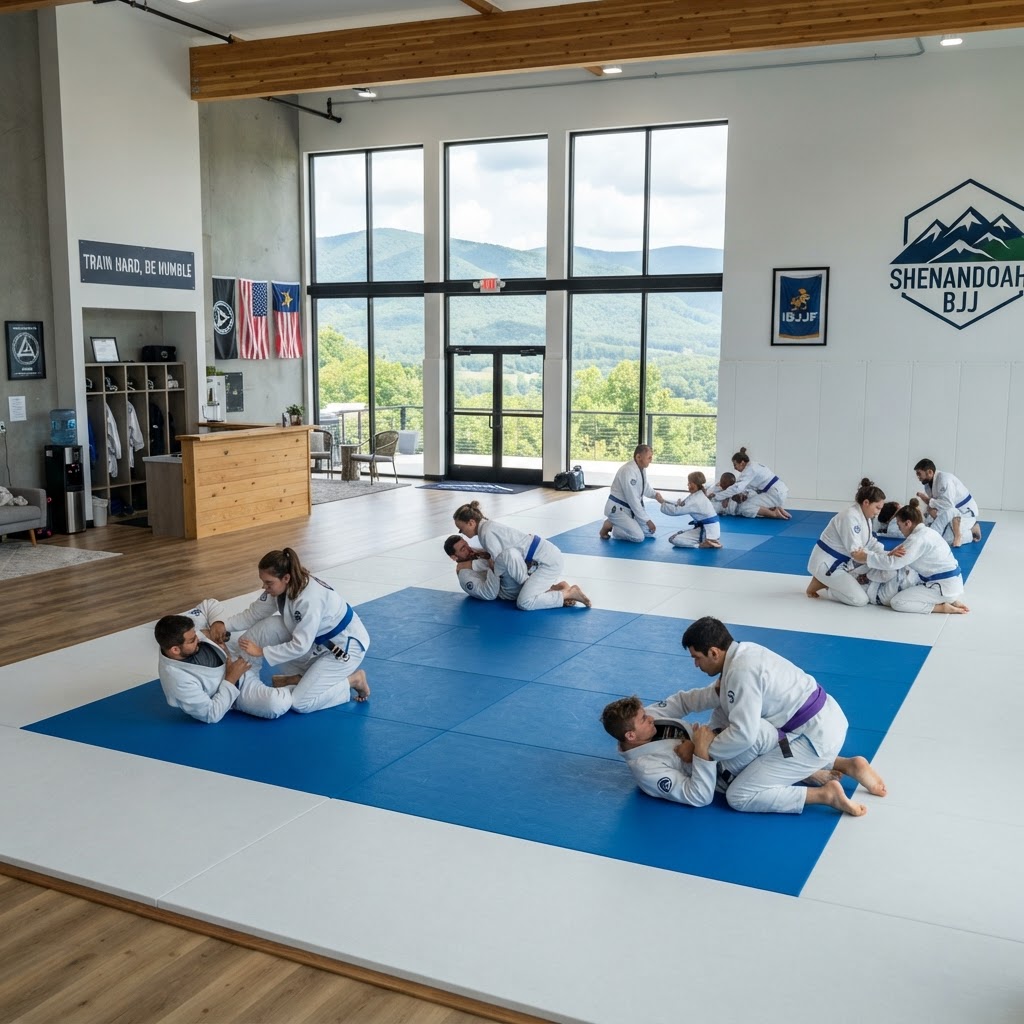
Here's what a typical beginner class looks like at Skyline Jiu-Jitsu in Waynesboro:
- Warm-up (10-15 minutes): Shrimping, hip escapes, forward rolls, and light calisthenics. These movements feel awkward at first, but they're the foundation of everything you'll learn.
- Technique instruction (20-30 minutes): The instructor demonstrates a fundamental technique — usually an escape, a sweep, or a basic submission.
- Drilling (15-20 minutes): You'll pair up and practice the technique with minimal resistance. This is where muscle memory starts to form.
- Positional sparring or live rolling (10-15 minutes): Beginners often start with positional sparring rather than full rolling. You might start in a specific position and try to escape or advance.
The most important thing to remember in week one: don't try to win. You're not there to prove anything. You're there to learn. Leave your ego at the door and absorb as much as you can.
Already wondering what BJJ actually is and where it came from? Read our complete beginner's guide to Brazilian Jiu-Jitsu for the full story.
Week 2: Learning to Breathe and Relax
By your second week, the initial shock wears off — and a new challenge appears. You'll notice that you're tensing up during drilling and sparring. Your grips are death-grip tight. Your shoulders are up by your ears. You're holding your breath.
This is completely normal. One of the biggest white belt tips you'll hear from every upper belt is simple: relax. Tension burns energy, kills technique, and makes you an easy target. The best grapplers look like they're barely trying because they've learned to use leverage and timing instead of brute force.
Here are some practical ways to relax on the mats:
- Breathe deliberately: Focus on exhaling when you execute a movement. If you catch yourself holding your breath, reset.
- Loosen your grips: A tight grip is a committed grip. Sometimes a loose hand is more useful because it can move freely.
- Pick one thing to focus on per roll: Instead of trying to win, pick a single goal — like maintaining posture in closed guard or keeping your elbows tight.
- Tap early and often: There's no shame in tapping. It's how you learn. Tap before a submission is locked in fully, reset, and try again.
If you're making some common beginner errors — and you will — our guide on 10 common BJJ beginner mistakes and how to fix them will help you course-correct fast.
Week 3: Your First Real Sparring Sessions
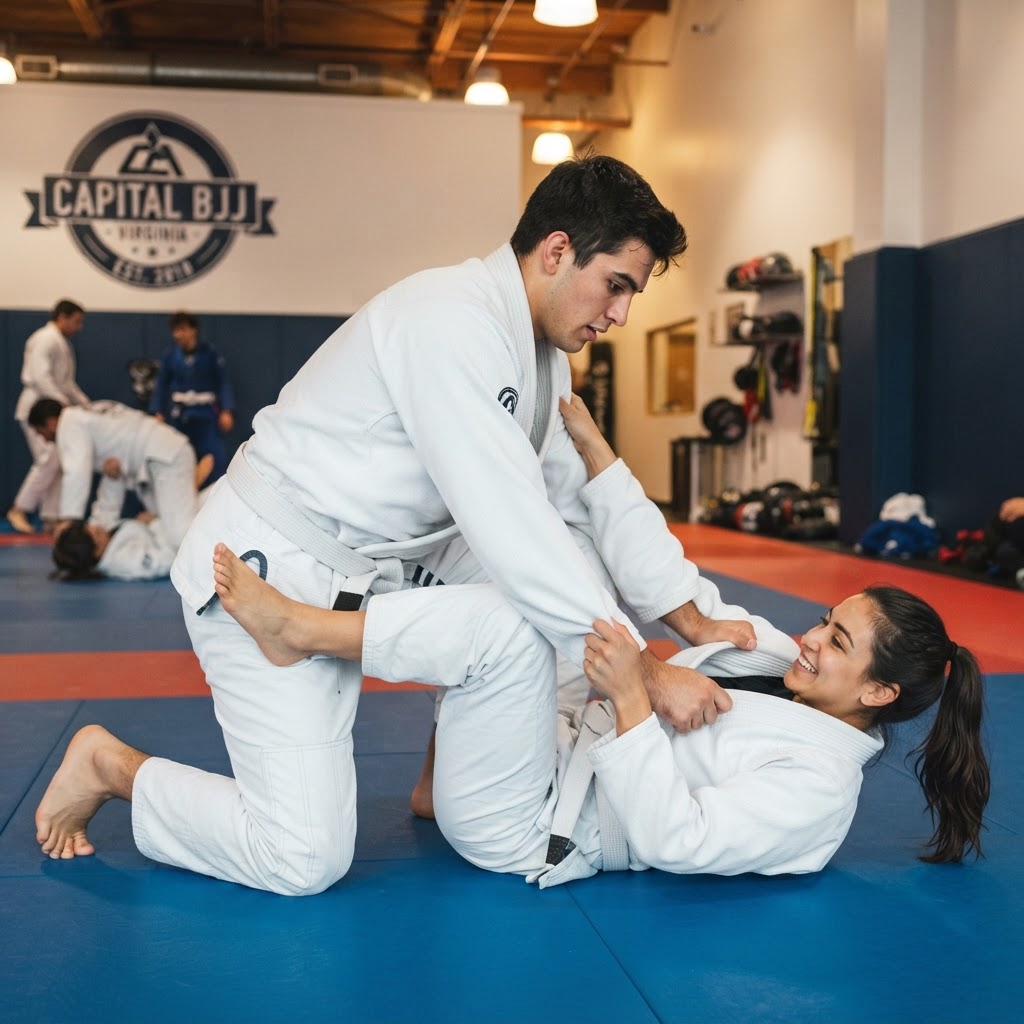
By week three, you'll likely start doing more live rolling. This is where BJJ sparring for beginners becomes both the most intimidating and the most rewarding part of training.
Sparring (or "rolling") in BJJ is different from sparring in striking arts. There's no getting punched in the face. Instead, it's a physical chess match where you're trying to apply techniques while your partner resists and counters. It's intense, but it's also incredibly safe when both partners are training responsibly.
Here's what to expect when surviving your first BJJ roll:
You're going to get tapped. A lot. This is not a failure — it's the process. Every time you get submitted, you're learning what not to do. Upper belts will often let you work into positions and then show you why your approach didn't work. That feedback loop is gold.
Focus on survival first. Before you can submit anyone, you need to learn how to not get submitted. Work on your defensive frames, your hip movement, and your ability to stay calm in bad positions. Defense is the foundation of everything in BJJ.
Pick the right partners. When you're new, look for training partners who are calm, controlled, and willing to help. At Skyline Jiu-Jitsu, our more experienced students love working with beginners — we remember what it was like. Avoid the person who's going 100% in every roll. There's no trophy for winning a Tuesday night open mat.
Communicate with your partner. If something feels dangerous or uncomfortable, say so. If you need to take a break, take one. BJJ is a conversation, not a competition — especially in the gym.
Want to understand the positions you'll find yourself in during sparring? Our BJJ positions explained guide breaks down every essential position you need to know.
Week 4: Building a Routine and Seeing Progress
By the end of your first month, something remarkable happens. You start to see it — the progress. It's subtle at first. A sweep that didn't work in week one suddenly connects. You escape side control for the first time. You make it through an entire roll without getting submitted. These small victories are what make BJJ so addictive.
But to see that progress, you need consistency. Here's how to build a sustainable training routine during your first month of BJJ and beyond:
READY TO TRY BRAZILIAN JIU-JITSU?
Claim a FREE trial class at Skyline Jiu-Jitsu today!
Serving Waynesboro, Charlottesville, Fishersville & the Shenandoah Valley
- Aim for 2-3 classes per week: This is the sweet spot for beginners. Enough frequency to build muscle memory, but not so much that you burn out or get injured.
- Rest and recover: BJJ is demanding on your body. Sleep well, eat well, and don't train through pain. Soreness is normal; sharp pain is not.
- Take notes after class: Write down what you learned, what worked, and what confused you. This simple habit will accelerate your learning dramatically.
- Ask questions: Don't be shy. Your instructors and training partners are resources. If something doesn't make sense, ask. That's what they're there for.
Many beginners in the Shenandoah Valley area worry about the commute. If you're driving in from Charlottesville or Fishersville, pick a schedule that works with your life and stick to it. Consistency beats intensity every time. Check our class schedule and pricing to find times that fit your week.
The Mental Side of BJJ for Beginners
Here's something nobody tells you about your first month: the mental challenge is bigger than the physical one. BJJ has a way of stripping away your ego and exposing your weaknesses in real time. There's no hiding on the mat. If you don't know a technique, it shows. If you're using strength instead of leverage, it shows. If you're holding your breath, it shows.
This is actually a gift. BJJ teaches you to be comfortable being uncomfortable. It teaches you to problem-solve under pressure. It teaches you that failure isn't final — it's just feedback. These lessons carry over into every part of your life: your job, your relationships, your mental health.
Many of our students in Waynesboro started training specifically for the mental benefits. If that resonates with you, our guide on BJJ for anxiety and mental health goes deeper into how the mats can become a sanctuary.
What to Expect Physically in Your First Month
Let's be honest about the physical side. Your body is going to go through some changes in the first 30 days:
- Soreness: You'll use muscles you didn't know existed. Core, hips, forearms, and neck will all be sore. This fades as your body adapts.
- Bruises: Minor bruising on your arms and legs is completely normal. Your skin will toughen up over time.
- Mat burn: Friction from the mats can cause mild abrasions, usually on your feet and elbows. Tape and athletic skin cream help.
- Improved conditioning: Even in just a month, you'll notice better cardio, core strength, and flexibility. BJJ is one of the most complete workouts you can do.
- Better sleep: Training hard and learning deeply improves sleep quality for most people. You'll fall asleep faster and sleep deeper.
If you're interested in the fitness and weight loss side of BJJ, read our guide on Brazilian Jiu-Jitsu for weight loss to see what's possible.
Common Questions From BJJ Beginners
Do I need to be in shape before starting BJJ?
No. This is the most common myth that keeps people from trying BJJ. You get in shape by doing BJJ. Showing up is the only prerequisite. We've had students start who couldn't do a single push-up — and within months, they were in the best shape of their lives.
Am I too old to start BJJ?
Almost certainly not. We have students who started in their 40s, 50s, and beyond. BJJ is often called "the gentle art" because it relies on technique and leverage, not size and strength. As long as you're cleared by your doctor for physical activity, you can train.
How often should a beginner train?
Two to three times per week is ideal for your first month. This gives you enough mat time to progress while allowing your body to recover between sessions. As your conditioning improves, you can increase your frequency.
Will I get hurt?
Injuries can happen in any physical activity, but BJJ is remarkably safe when trained with good partners and qualified instructors. The key is to tap early, train with control, and listen to your body. At Skyline Jiu-Jitsu, safety is our top priority — especially for beginners.
What if I can't remember the techniques?
Nobody does in their first month. BJJ techniques take hundreds of repetitions to internalize. Don't worry about remembering everything. Focus on understanding the concepts — frames, leverage, hip movement — and the specific techniques will come with time.
Tips for Making the Most of Your First Month
To wrap up, here are the golden rules for BJJ for beginners navigating that critical first month:
- Show up consistently. Two classes a week for a month beats five classes in one week followed by two weeks off.
- Focus on fundamentals. Don't chase flashy submissions. Master the basic escapes, sweeps, and positional controls. They'll carry you further than any flying armbar.
- Be a good training partner. Train with control, communicate openly, and match your partner's intensity. The culture of the gym depends on everyone being good to each other.
- Track your progress. Keep a training journal. Note what you drilled, what clicked, and what you want to work on next class.
- Have fun. Seriously. BJJ is hard, but it's also incredibly fun. Enjoy the process of learning. The belts will come if you stay.
If you're in the Waynesboro area — or anywhere in the Shenandoah Valley, including Charlottesville and Fishersville — we'd love to welcome you to the mats. Skyline Jiu-Jitsu is built for beginners. Our instructors are patient, our community is supportive, and our curriculum is designed to take you from day one to black belt and beyond.
Related Posts
- What Is Brazilian Jiu-Jitsu? A Complete Beginner's Guide to the Gentle Art
- What to Wear to Your First BJJ Class: A Beginner's Guide
- 10 Common BJJ Beginner Mistakes and How to Fix Them Fast
- Beginner Jiu Jitsu Near Me: What to Expect at Your First Class in Waynesboro, VA
- BJJ Positions Explained: The Essential Positions Every Student Should Know
- The Complete BJJ Belt System Explained: Timeline, Stripes, and What to Expect from White to Black Belt
READY TO TRY BRAZILIAN JIU-JITSU?
Claim a FREE trial class at Skyline Jiu-Jitsu today!
Serving Waynesboro, Charlottesville, Fishersville & the Shenandoah Valley