From the Mat to the Mats: How to Transition From Wrestling to BJJ Successfully
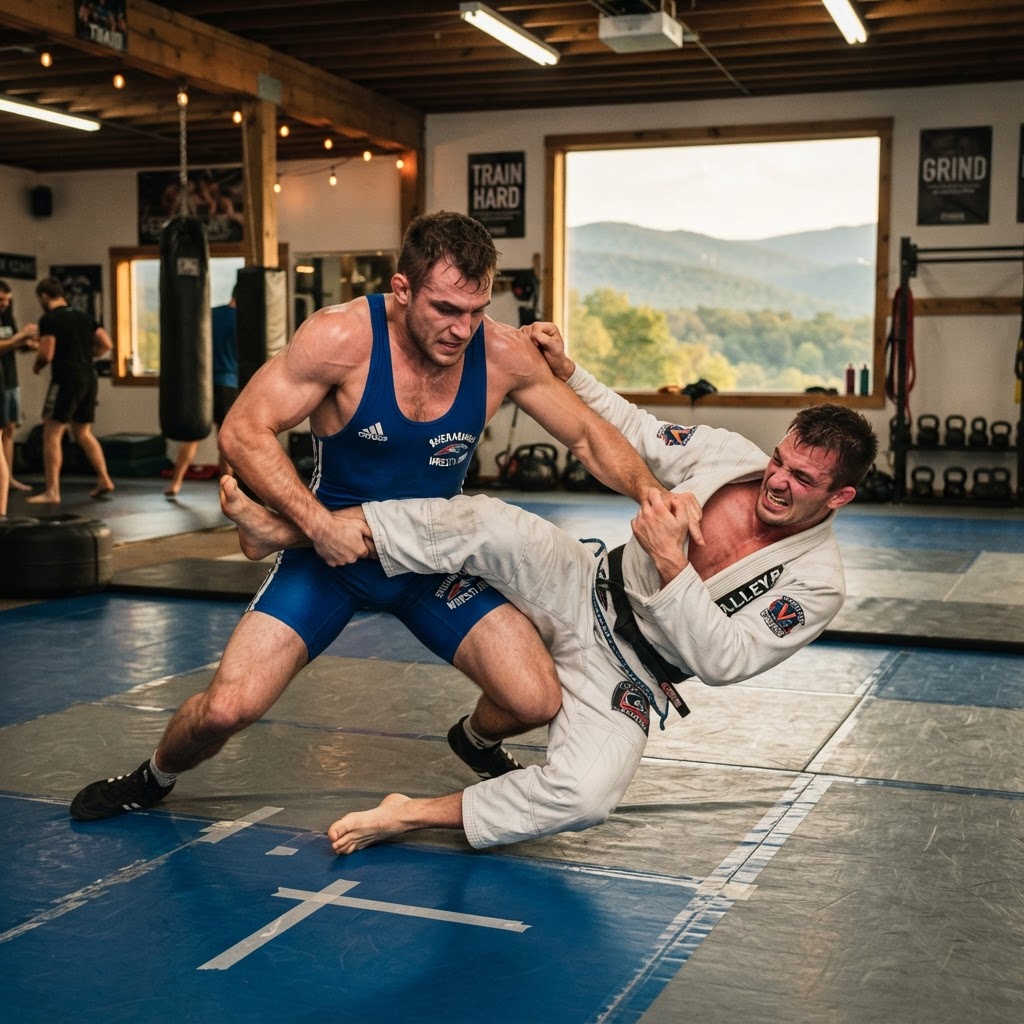
If you grew up wrestling — whether in a Waynesboro high school program, a youth league in Fishersville, or a collegiate circuit anywhere in the Shenandoah Valley — you already have one of the strongest possible foundations for Brazilian jiu-jitsu. The wrestling to BJJ transition is one of the most natural crossovers in all of martial arts, and wrestlers who make the switch often progress faster than any other category of beginner.
But that doesn't mean it's seamless. Wrestlers bring incredible habits to the jiu-jitsu mats — explosive takedowns, relentless pressure, elite conditioning, and a competitive mindset forged through years of grueling practices. They also bring a few habits that can get them choked out in a hurry. Understanding both sides of that coin is the key to a successful transition from wrestling to BJJ.
At Skyline Jiu-Jitsu in Waynesboro, Virginia, we've coached plenty of former wrestlers through their first weeks and months of BJJ. Here's everything you need to know about making the switch — the advantages you bring, the pitfalls to watch for, and the specific adjustments that will fast-track your progress.
Why Wrestlers Excel at BJJ
Let's start with the good news. If you're a wrestler starting BJJ, you're walking in with a massive head start. Here's why:
1. You Already Understand Grappling
Most people who try BJJ for the first time have never been in a grappling exchange. They don't know what it feels like to have someone's weight on top of them, to fight for an underhook, or to chain a takedown attempt into a scramble. You do. You've spent years developing body awareness, leverage, and spatial control on the mat. That instinctive understanding transfers directly to jiu-jitsu.
Your brain already processes grappling exchanges at a speed that non-wrestlers can't match. When someone grabs a collar tie or shoots on you, you react before you think — and that reaction time is gold in BJJ.
2. Your Takedown Game Is Already Elite
One of the biggest gaps in modern BJJ is the standing game. Many jiu-jitsu practitioners rarely train takedowns, which means a wrestler with a solid double-leg or single-leg is immediately dangerous from the feet. You won't need to learn how to take someone down — you'll need to learn how to finish the takedown into a position that sets up submissions instead of just pinning.
For a deep dive into the specific takedowns that translate best, check out our guide on wrestling takedowns for BJJ.
3. Your Conditioning Is Built for This
Wrestling is widely considered the most physically demanding sport on the planet. The gas tank you built through years of live goes, sprints, and weight cutting is exactly what jiu-jitsu requires. While your BJJ classmates are gassing out after three five-minute rolls, you'll be the one asking for a fourth.
4. You Know How to Compete
Wrestlers understand pressure. You've been in tournaments where one loss ends your day. You've cut weight, faced opponents in front of crowds, and learned to perform when it matters. That mental toughness translates beautifully to BJJ competitions — and to the daily grind of showing up to train when you're sore and tired.
The Pitfalls: What Gets Wrestlers in Trouble
Now for the honest part. The wrestling background BJJ advantage is real, but it comes with a set of habits that can slow your progress or even get you injured if you don't adjust. Here are the most common traps:
1. Giving Up Your Back
This is the #1 mistake wrestlers make in BJJ. In wrestling, giving up your back is often a strategic choice — you roll through to escape a bad position and re-face your opponent. In jiu-jitsu, giving up your back is a death sentence. The rear naked choke is one of the highest-percentage submissions in the sport, and a good BJJ player will take your back and finish you in seconds if you turn away.
The fix: Never turn away from your opponent in BJJ. If you're in a bad position, fight to face them. Learn to frame and recover guard instead of rolling to your stomach. This single adjustment can save you months of getting submitted.
2. Driving Forward Without a Plan
Wrestlers are conditioned to drive forward, apply pressure, and never stop moving. That's great in a wrestling match where the goal is to pin your opponent's shoulders to the mat. But in BJJ, driving forward blindly into someone's guard can walk you straight into a triangle, armbar, or guillotine.
The fix: Slow down and think in terms of position before submission. In BJJ, position comes first. Before you apply pressure, understand where you are, what your opponent's attacking options are, and what your escapes look like. If you haven't already, read through our guide to BJJ positions explained — it'll give you the framework you need.
3. Over-Reliance on Strength and Explosiveness
Wrestlers are strong. Wrestlers are explosive. And when a technique isn't working, the default wrestler response is to go harder. In BJJ, that approach will work against white and early blue belts — and then it won't. Against experienced grapplers, muscling through techniques leaves you exhausted and vulnerable to counters.
The fix: Learn to flow before you learn to crush. Spend your first few months deliberately rolling at 50% intensity. Focus on technique, timing, and sensitivity — feeling what your opponent is doing before reacting. The strength and explosiveness will always be there. What you need to add is efficiency.
4. Not Learning the Guard
In wrestling, being on your back is losing. There's no guard, no closed guard, no spider guard, no De La Riva. So when wrestlers start BJJ, they often resist playing from their back at all costs — fighting to get on top even when staying on bottom and working guard would be the smarter, more technical play.
The fix: Embrace the guard as a weapon, not a punishment. The guard is one of BJJ's most defining positions. It allows you to attack and defend from the bottom — something that doesn't exist in wrestling. Spend time learning closed guard, open guard, and half guard. The sooner you're comfortable on your back, the faster you'll become a complete grappler.
A Step-by-Step Transition Plan for Wrestlers
Ready to make the transition from wrestling to BJJ? Here's a practical roadmap for your first 90 days:
Weeks 1-2: Check Your Ego at the Door
Your first week of BJJ will be humbling. You'll get submitted by people smaller than you, people who look like they've never trained, and people who you'd destroy in a wrestling match. That's normal. BJJ is a different game with different rules, and the submissions game is something wrestling doesn't prepare you for at all.
Focus on surviving. Learn to tap early and often. Don't fight submissions out of pride — a late tap is how shoulders and elbows get wrecked. Check out our guide on common BJJ beginner mistakes to see what else to watch for.
Weeks 3-6: Build Your Defensive Foundation
Before you learn any attacks, learn to survive and escape. This means:
- Defensive posture — keeping your elbows tight, chin tucked, hands protecting your neck
- Frame and shrimp — the fundamental escape mechanics that replace wrestling's bridge-and-roll
- Submission defense — recognizing when a choke or armbar is being set up and defending before it's locked in
- Guard recovery — getting back to guard when someone passes, instead of turning to your stomach
READY TO TRY BRAZILIAN JIU-JITSU?
Claim a FREE trial class at Skyline Jiu-Jitsu today!
Serving Waynesboro, Charlottesville, Fishersville & the Shenandoah Valley
This phase will feel slow. That's intentional. Defense is what keeps you safe and lets you train for decades. Wrestlers who skip this phase tend to get injured or frustrated and quit within the first month.
Weeks 7-12: Integrate Your Wrestling
Now the fun starts. Once you have a defensive foundation, you can start integrating your wrestling into your BJJ game. This is where BJJ for wrestlers becomes less about learning from scratch and more about adapting what you already know:
- Takedown entries — Use your doubles, singles, and snap-downs to get the fight to the ground. Just remember: the goal isn't a pin — it's a dominant position that sets up submissions.
- Top pressure — Your ride from wrestling translates beautifully to side control and mount. Just learn to vary your pressure so you're not driving into a submission attempt.
- Scrambling — Wrestlers are the best scramblers in all of grappling. Use that instinct to win positional battles and recover lost positions. Just make sure you're scrambling toward a better position, not just away from a bad one.
- Grip fighting — The collar tie and wrist control battles from wrestling are incredibly useful in the gi. Your hand fighting will be sharper than most BJJ players' at your level.
Wrestling vs BJJ: Understanding the Key Differences
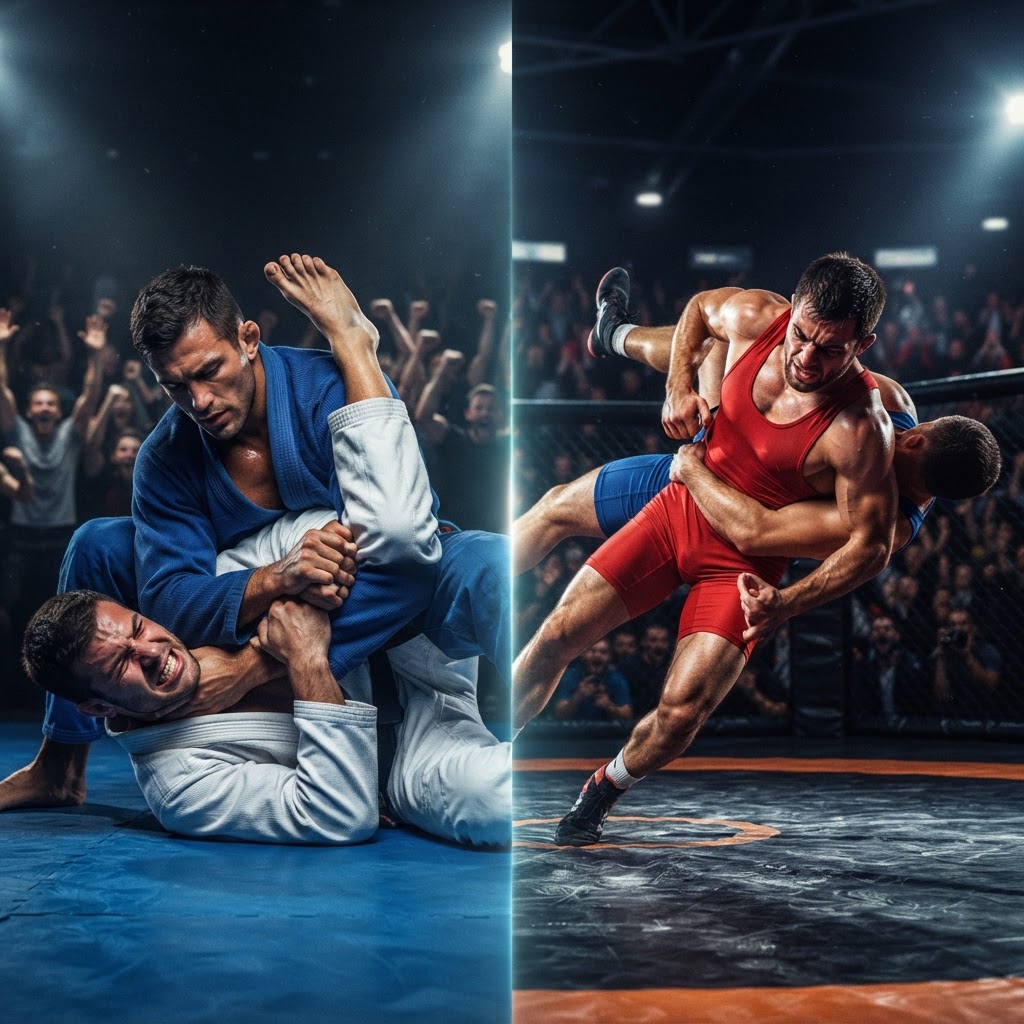
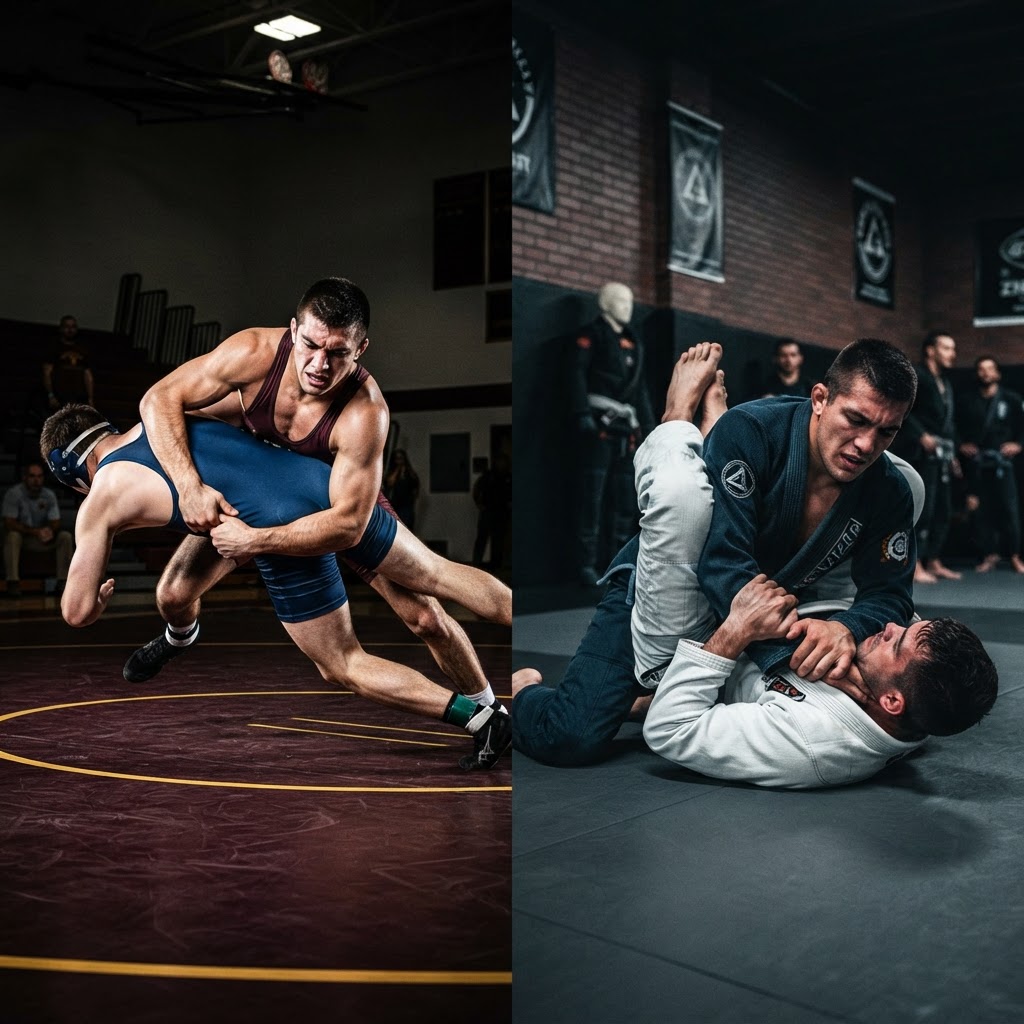
If you want a comprehensive breakdown of how the two sports compare — rules, scoring, techniques, and culture — read our full guide on BJJ vs wrestling. But here's the short version for transitioning wrestlers:
- Goal: Wrestling wants you on your back with shoulders pinned. BJJ wants you to submit (tap out) — which can happen from any position.
- Positions: Wrestling has top, bottom, and neutral. BJJ has mount, side control, knee on belly, back control, various guards, and more. Positional hierarchy is more complex.
- Submissions: Wrestling has none. BJJ has chokes, armlocks, leg locks, and shoulder locks. This is the biggest adjustment for wrestlers.
- The gi: Wrestling has no gi. BJJ can be trained with or without it. The gi adds grip fighting, lapel chokes, and a slower, more technical game. Try both — your wrestling transfers better to no-gi initially, but the gi will make you more technical long-term.
For more on the gi vs no-gi decision, read our guide on gi vs no-gi BJJ.
What to Wear and What to Expect at Your First Class
If you're coming from wrestling, the first thing you'll notice is that BJJ has a different dress code. Wrestling singlets are out; gis (or rash guards and shorts for no-gi) are in. Check out our complete guide on what to wear to your first BJJ class for the full breakdown.
As for what to expect — most BJJ classes follow a similar structure:
- Warm-up — Usually 10-15 minutes of calisthenics, shrimping, and mobility work. Wrestlers typically find this easy.
- Technique instruction — The coach demonstrates a technique or sequence, and you drill it with a partner. This is more structured than wrestling practices, which tend to be more live-go heavy.
- Positional sparring — You'll often drill from a specific position (e.g., start in someone's guard and try to pass). This is great for wrestlers because it gives you focused reps.
- Live rolling — The equivalent of wrestling live goes, but typically 5-minute rounds with multiple partners. You'll start from the knees or standing depending on the gym.
One key difference: in wrestling, you wrestle to win. In BJJ, especially in the beginning, you roll to learn. Tap freely, experiment with positions, and don't keep score. The ego that helped you in wrestling tournaments will actively slow your BJJ progress.
Wrestling to BJJ: The Mental Shift
The physical transition from wrestling to jiu-jitsu is relatively quick. The mental transition takes longer. Here's what we tell every wrestler to jiu jitsu convert at our Waynesboro academy:
You're not a beginner — but you're not an expert either. You have world-class grappling instincts, elite conditioning, and a competitive drive that most BJJ beginners would envy. But you're missing an entire dimension of the sport: submissions and submission defense. Respect that gap. Be a white belt with pride. Ask questions. Let lower-ranked students who have been training longer teach you things. The humility will pay off.
Train consistently, not intensely. Wrestlers are used to killing themselves every practice. In BJJ, you can train every day if you want — but only if you're not going 100% every roll. Learn to train at different intensities. Roll light with partners who are smaller or less experienced. Go hard with partners who can handle it. Consistency beats intensity over a 10-year horizon.
Compete when you're ready — and not before. Wrestling competition is a part of the sport from day one. In BJJ, you can compete as a white belt, but we recommend waiting 3-6 months so you understand the rules and submission game. When you do compete, your wrestling background will give you a massive edge in the takedown and top-game departments.
The Belt System: A Different Path
In wrestling, your level is determined by your weight class, your win record, and your tournament placement. In BJJ, it's determined by a belt system that takes most people 10+ years to reach black belt. The belts are white, blue, purple, brown, and black — with stripes at each level to mark progress.
As a wrestler, you'll likely move through the white belt ranks faster than average. But don't expect to skip steps. The belt system exists because jiu-jitsu has a vast technical landscape that wrestling doesn't touch — submissions, guards, escapes, and positional strategy that take years to absorb. Read our complete guide to the BJJ belt system to understand the timeline and what to expect.
Start Your Transition at Skyline Jiu-Jitsu
If you're a current or former wrestler in Waynesboro, Charlottesville, Fishersville, Staunton, or anywhere in the Shenandoah Valley, Skyline Jiu-Jitsu is the perfect place to make the transition. Our coaches understand the wrestler's mindset and can help you channel your existing skills into jiu-jitsu success — while helping you avoid the pitfalls that derail so many wrestlers in their first months.
We offer a free trial class for new students, so you can experience a BJJ class firsthand with zero commitment. Whether you're a high school wrestler looking for an off-season sport, a college wrestler staying competitive after eligibility, or someone who wrestled years ago and misses the grind — you'll feel at home on our mats.
Related Posts
- Wrestling Takedowns for BJJ: 7 Stand-Up Skills Every Grappler Should Learn
- BJJ vs Wrestling: Key Differences, Rules, and Which Martial Art Is Right for You?
- Wrestling for BJJ: 7 Ways Wrestling Improves Your Brazilian Jiu-Jitsu
- What Is Brazilian Jiu-Jitsu? A Complete Beginner's Guide to the Gentle Art
READY TO TRY BRAZILIAN JIU-JITSU?
Claim a FREE trial class at Skyline Jiu-Jitsu today!
Serving Waynesboro, Charlottesville, Fishersville & the Shenandoah Valley